


The phrase “company law” is not used at all in the legislation, official and unofficial communications.
Farkhad Karagussov,
Institute of Private Law of Caspian University,
chief researcher, professor
(Almaty, Kazakhstan),
DEVELOPMENT OF COMPANY LAW IN KAZAKHSTAN: MAIN ISSUES AND TRENDS
1. The terms of “company law” and “corporate law” do not have their legal definitions in the law of Kazakhstan.
However the concept of corporate law is widely referred to in the sphere of informal discussions as well as on the level of certain programming or conceptual documents concerning legal development and improvement of the regulatory framework for and practice of the corporate governance.
For example, on 28 March 2011 the Ministry of Justice of the Republic of Kazakhstan has adopted the Concept paper concerning development of corporate legislation of Kazakhstan (the “Corporate Law Development Paper ”) where, at the same time, clear statements were made that there is no legal definition of the notion of a “corporation” existing in Kazakhstani legislation, nor there terms of “corporate law” and “corporate legislation” are fixed and widely accepted in the law and practice, as well as no place for corporate law has been determined in the legal system of Kazakhstan.1 These conclusions still remain true today.
2. Our studies show that in the European legal environment there notions of “company law” and “corporate law” are used as synonyms in identifying a legal background for:
(i) creation of legal entities formed based on association of persons with the purpose to earn profit and (ii) conduct of economic activities by such legal entities observing adequate balance in protecting rights of a company, its shareholder and creditors as well as of public interest. The company (or corporate) law is called to become a “special private law” combining laws on capital companies, on general partnerships and limited partnerships.2
Depending on terms of such association the legal entities are classified into two groups – partnerships and companies.
Formation of a partnership allows their members (partners, participants) to conduct entrepreneurial activity based on joint property, common management and unlimited liability of members of the partnership who often are required or acknowledged to have a status of entrepreneurs. In turn, companies are set up, and they perform their activities, on the basis of separation of participation in their capital from their management and limited liability of their members who, in general, can be considered as investors in the company, not as entrepreneurs.
In some of European jurisdictions the term “company law” applies to regulate both partnerships and companies, in others it regulates companies only.
(Please see slide 1)
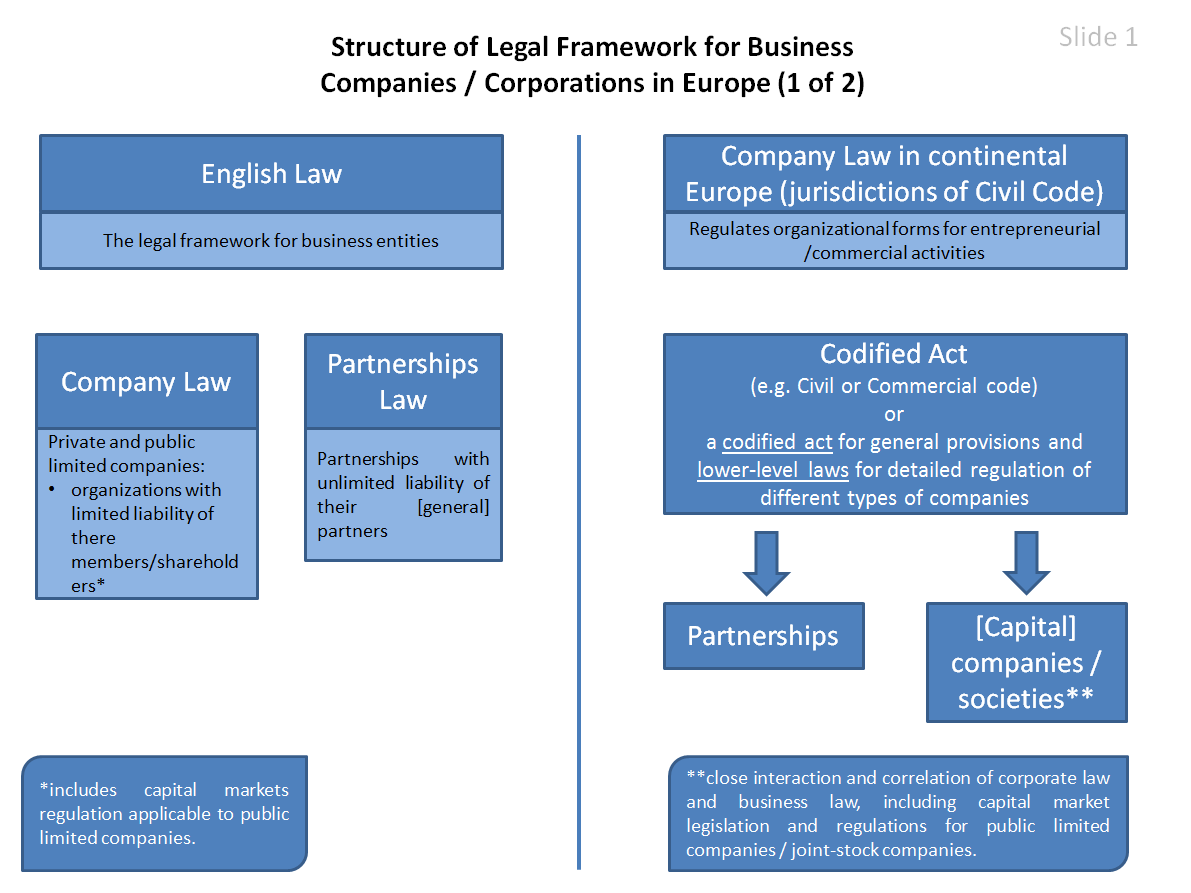
For example, in English law companies are treated as distinct from partnerships and there also distinction exists between partnership law and company law.
Although it is said that “the distinction between partnership and companies if often merely one of machinery and not of function”, nevertheless (as such distinction entails separate regulation of legally significant specifics of these both types of companies) there relevant legal provisions are largely codified in different acts: in the Partnership Act 1890 and Companies Act 1985 respectively.3
In the most jurisdictions of Continental Europe (in the civil-code countries) company law includes regulation of both types of the business entities: partnerships and companies.
All business entities formed based on association of persons for common object are combined under the term “company” and then all the companies are classified to be either partnerships or companies. For instance, that is true for German law.4 Similar approach can be found in French Code du Commerce 2000: all forms of business entities with separate legal personality have been united under one term of a commercial company (societe ) regulated in Book II of the Code including general and limited partnerships, company with limited liability and different types of joint-stock companies (societe par actions ) such as ordinary JSC (SA ), simplified JSC (SAS ) and limited partnership issuing shares (SCA ).5 The same is obviously true for the Estonian Commercial Code: §2 applies the general term of a “company” with respect to general partnerships, limited partnerships, private limited companies, public limited companies or commercial associations, as well as to other companies if prescribed by law.
Полная версия